Important pages should be reachable within a few clicks of your homepage, through ordinary links a search engine can follow. Pages buried deep in a site, or reachable only through menus a crawler can't use, get found less by people and by Google. Second Opinion checks click depth, whether your navigation uses crawlable links, and whether your sitemap agrees with the pages your site actually links to.
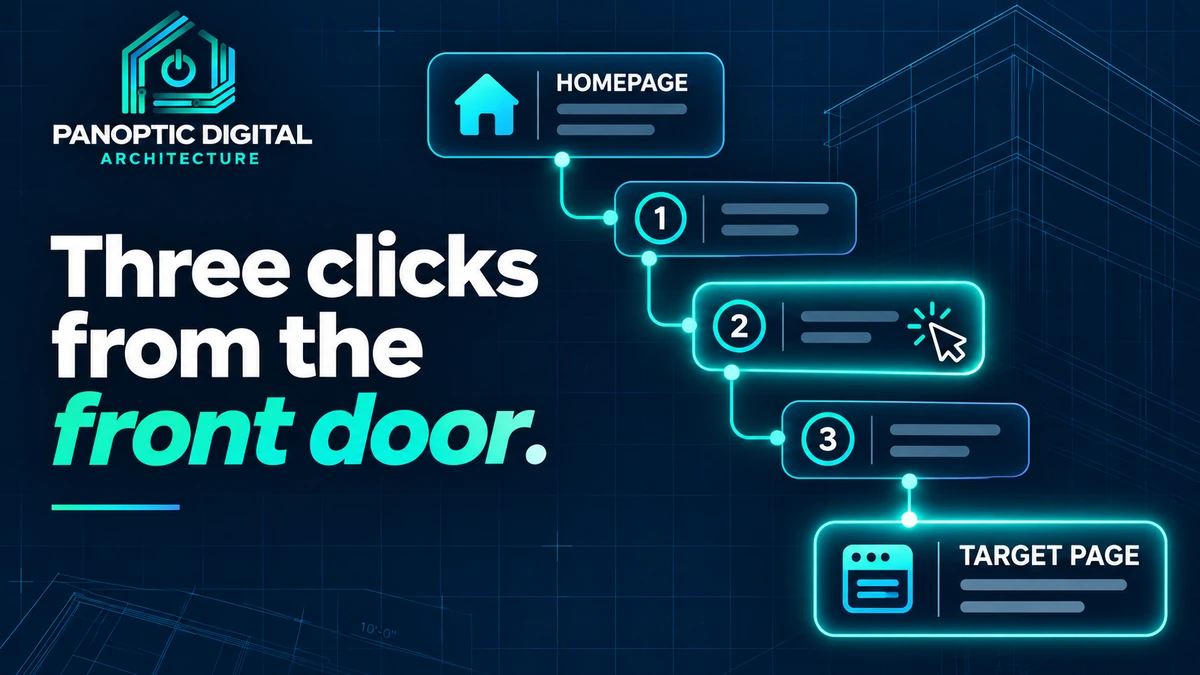
Here's a quick one. Open your homepage and find the page that makes you the most money. Your best service, your quote form, your booking page.
How many clicks did it take?
If the answer is one or two, you're in good shape. If it's four or five, or you had to use the search box, that page is buried.. and buried pages get found less, by people and by search engines.
Why distance matters
Search engines find pages by following links, starting from the pages they already know. Your homepage is the one they know best. Every click away from it is a little less attention.
A large study of real websites found that pages with more links pointing to them from their own site get more clicks from Google. Buried pages are exactly the ones that miss out. It's good evidence, not airtight, and the check is weighted that way.
What we check
- Click depth. Whether your important pages sit within a few clicks of the homepage, or have no path from it at all.
- Crawlable links. Whether your menu is made of ordinary links. Some menus only work through buttons or scripts a crawler can't follow, so the pages behind them stay hidden from it.
- Your sitemap. If you have one, whether it works and whether it agrees with your actual links. A page listed in the sitemap but linked from nowhere is usually a page somebody forgot about.
All three are part of the crawlability half of your Website Score. The sitemap check carries the least weight of any scored check, because it rests on our own reasoning rather than a published study.. and we'd rather say so. If you don't have a sitemap, that check doesn't apply to you.
An afternoon of menu edits
Most of this is moving links, not building pages.
-
List your money pages
Write down the three to five pages that matter most to your business. Usually that's your main services, your contact or quote page, and maybe a page that proves you're good at what you do, like reviews or past projects.
You have a short written list of the pages you most want people to find.
-
Count the clicks to each one
Start on the homepage every time. Count the clicks to each page on your list, first on a computer and then on your phone. Phone menus often hide more than desktop ones do.
Anything more than three clicks away is buried. Anything you can't reach at all without the search box is orphaned.
Every page on your list has a click count next to it, for your computer and for your phone.
-
Bring the buried ones closer
You usually don't need to rebuild anything. Add a link from the homepage, from the main menu, or from a service overview page that already gets visits.
Use words that say what the page is. "Pond repair" is a better link than "Learn more," for people and for search engines.
Every page on your list is three clicks or fewer from the homepage, on your phone.
-
Make sure the menu is made of real links
This one is for whoever maintains your site. Ask them: "Is our main menu built from standard links, or does any of it depend on JavaScript to work?"
If any of it depends on scripts, the pages behind it may be hidden from a crawler even though they work fine for you. Your Second Opinion report flags this if it found it.
Your website person has told you, in writing, that the main menu uses standard links.
-
Check that your sitemap agrees
If you have a sitemap, it usually lives at your web address followed by /sitemap.xml. Open it. It should load, and every page in it should be a page you still want.
Your report lists any pages that appear in the sitemap but aren't linked from anywhere on the site. Link to them, or take them out.
Your sitemap opens without an error, and every page in it is linked from somewhere on your site.